


Finding Common Ground in Clatsop County
By Jeff Quinn and Michelle Hyman
Last month we traveled to Astoria, Oregon, for what we expected would be a fairly typical implementation meeting. Our team was gathering with community partners to reflect on the first year of Books from Birth in Clatsop County and begin planning for year two. The conversation began with lessons learned and implementation updates, but it soon became clear that we would leave with a much broader perspective on what makes community partnerships successful.
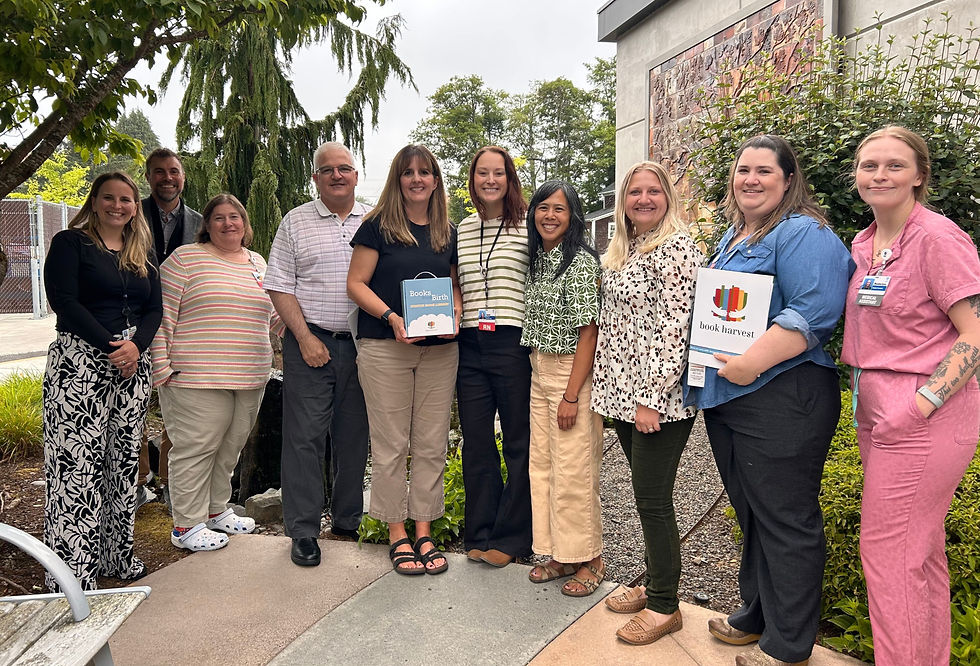
As the meeting unfolded, we found ourselves listening less to the implementation details and more to why each organization had chosen to invest in the work in the first place. It was wonderful to watch a community describe how different systems and stakeholders found common ground around children and families. What also captured our attention was that while everyone wholeheartedly supported the initiative, each organization did so for a different reason.
The Northwest Early Learning Hub began this work in 2024 as part of its charge to advance a regional early literacy strategy. It saw an opportunity to invest state resources in a universal approach that could unite partners who had not traditionally worked side by side. Books from Birth wasn't simply another program — it became a vehicle for connecting healthcare, education, philanthropy, and early childhood partners around a shared investment in young children.
Hospital leaders and the implementation team spoke about the birth of a child as one of the few moments when nearly every family can be reached with trusted information, encouragement, and support. They saw Books from Birth as a way to strengthen relationships with parents, reinforce the importance of early literacy from the very beginning of a child's life, and introduce families to resources that extend beyond the hospital walls.
The local school district brought yet another perspective. District leaders had long recognized the importance of supporting children from birth and promoting early literacy. As new state investments became available for early childhood, they were looking for ways to make those resources meaningful for families before children ever entered a classroom. A universal program like Books from Birth offered a natural way to invest in future learners years before kindergarten begins.
As we listened, we realized no one around the table was asking others to adopt their mission or to work toward their goals first. Instead, they were acknowledging something more profound: none of their missions existed in isolation. This happens in collaborative meetings all the time, but it was inspiring to see it in action.

The Northwest Early Learning Hub understood that a regional literacy strategy would be stronger with healthcare and education at the table. The hospital recognized that healthy child development continues long after families leave the maternity unit. The school district understood that readiness begins years before the first day of kindergarten. Each organization brought its own expertise, responsibilities, and priorities, while recognizing that better outcomes for children and families require partnership.
As we reflected on the meeting during our trip home, we kept coming back to how natural the conversation had felt. No one was defending territory. No one was competing for ownership. The discussion wasn't about whose mission mattered most but about how each organization could contribute what it does best to achieve something greater than any one partner could accomplish on its own. It also reminded us that, in many ways, we already know what works.
We know that investing early in children and families has lasting benefits. We know that collaboration across education, healthcare, and community organizations leads to stronger outcomes for families. We know that families are more likely to engage when trusted partners meet them where they are, with practical support and encouragement. The challenge isn't discovering new ideas. More often, it's creating the conditions for those ideas to take root and thrive.
Astoria reminded us that communities don't necessarily need to start from scratch. They already have organizations committed to children and families — dedicated leaders, trusted institutions, and a shared desire to see children thrive. Sometimes the next step isn't building something entirely new; it's recognizing how those existing strengths can be intentionally connected around a common purpose. That's what we carried home from Oregon: sometimes the most important work is simply creating the opportunity for those strengths to come together.